
Search engines are changing how people discover businesses, compare services, and make buying decisions. Today, users do more than type a few words into Google. They ask detailed questions, explore AI-generated answers, compare different providers, and look for trustworthy recommendations before contacting a business.
For companies operating in competitive markets such as Delhi NCR, this shift creates both opportunities and challenges. Traditional search engine optimization remains important, but businesses must also understand how their content can be discovered, understood, and referenced by AI-powered search experiences.
A well-planned SEO services in Delhi NCR strategy should therefore focus on more than keyword rankings. It should help businesses attract relevant visitors, answer customer questions, build credibility, and turn online visibility into genuine inquiries.
This guide explains how artificial intelligence is influencing SEO, what Answer Engine Optimization (AEO) and Generative Engine Optimization (GEO) mean, and how businesses can improve their chances of appearing in Google Search, AI Overviews, and other AI-driven discovery platforms.
What Is AI SEO and Why Does It Matter?
AI SEO refers to using artificial intelligence to support SEO research, content planning, technical analysis, search-intent understanding, and performance improvement. It can also describe the process of preparing website content for search experiences that use AI to generate answers.
AI tools can help marketers identify content gaps, organize topics, summarize large datasets, and discover questions potential customers ask. However, AI-generated content alone does not automatically achieve better rankings.
Google’s guidance continues to emphasize helpful, reliable, people-first content supported by sound technical SEO practices. Businesses should use AI to improve research and efficiency while ensuring that published information is accurate, original, and genuinely useful.
How AI Is Changing Search Behavior
AI-powered search experiences are influencing how people discover information in several ways:
- Conversational queries: Users increasingly ask complete questions instead of entering only short keywords.
- Direct answers: Search experiences may summarize information before users visit individual websites.
- More detailed comparisons: People can explore pricing factors, features, benefits, and alternatives through longer queries.
- Context-based discovery: Search systems interpret the meaning and purpose of a query rather than relying only on exact keyword matches.
- Multiple discovery channels: Websites, reviews, videos, business profiles, and credible third-party publications can all contribute to brand discovery.
For businesses, the practical goal is to make their information easy for both people and search systems to understand.
What Are SEO, AEO, and GEO?
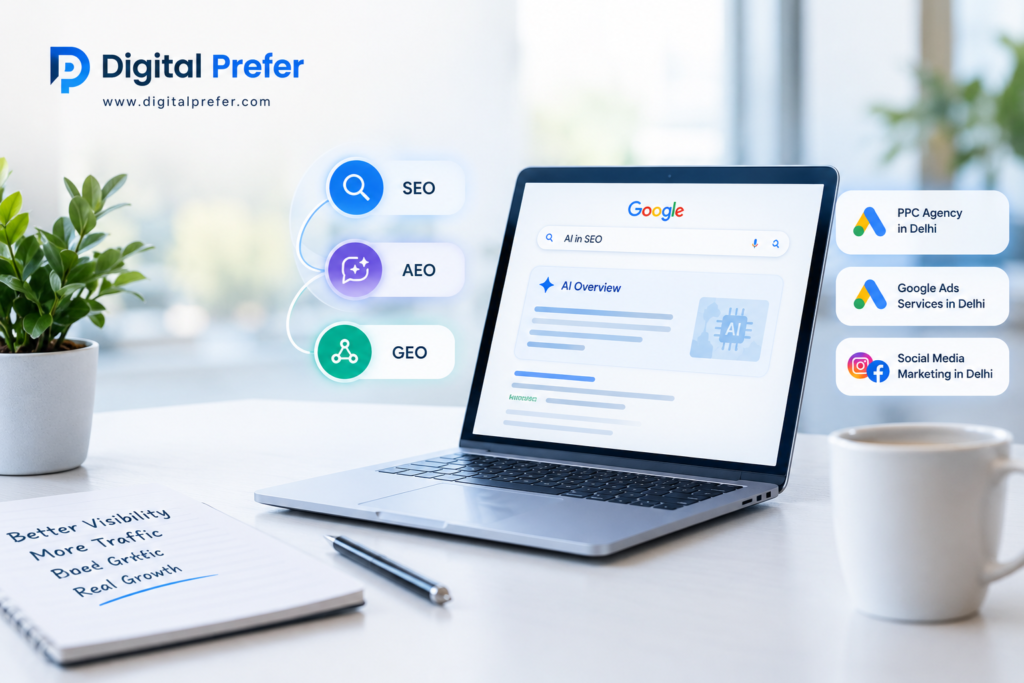
SEO, AEO, and GEO are closely related approaches, but they emphasize different aspects of online visibility.
Search Engine Optimization (SEO) improves a website’s ability to be discovered and ranked in traditional organic search results.
Answer Engine Optimization (AEO) focuses on making content useful for answering specific questions clearly. This includes definitions, step-by-step explanations, concise answers, and well-organized FAQs.
Generative Engine Optimization (GEO) focuses on improving the likelihood that a brand or its content will be discovered, referenced, or mentioned in AI-generated answers.
These approaches overlap. A technically accessible website with useful content and clear information can support all three.
SEO vs. AEO vs. GEO
| Factor | SEO | AEO | GEO |
| Primary objective | Improve organic search visibility. | Answer user questions clearly. | Improve visibility in AI-generated answers. |
| Content approach | Relevant, useful, comprehensive content | Direct answers and structured explanations | Clear, credible, extractable information |
| Main focus | Rankings, clicks, and organic traffic | Question-based discovery | Brand mentions, citations, and recommendations |
| Helpful formats | Service pages, blogs, landing pages | FAQs, how-to guides, definitions | Expert guides, comparisons, original insights |
| Performance measurement | Rankings, impressions, clicks, conversions | Question visibility and relevant search performance | AI mentions, citations, referral traffic, brand sentiment |
No single format guarantees visibility across these systems. Businesses should combine strong fundamentals with content that genuinely addresses their audience’s needs.
How Do Google AI Overviews Work?
Google AI Overviews can provide AI-generated summaries for certain searches and include links to relevant websites for further exploration. They are designed to help users understand complicated topics or questions more quickly.
For example, someone searching for a digital marketing partner may ask Google which services a business should evaluate before selecting an agency. An AI-generated answer may summarize important considerations and link to relevant sources.
For a website to be eligible to appear as a supporting link in Google AI features, its page must meet the applicable Google Search technical requirements and be eligible to appear with a search snippet. However, eligibility does not guarantee that Google will select or display the page.
Businesses should focus on the following practices:
- Ensure important pages can be crawled and indexed.
- Publish useful, original information that addresses real customer questions.
- Use descriptive page titles and clear headings.
- Make essential information available in readable text.
- Support explanations with relevant images, examples, and evidence.
- Keep business information accurate and consistent.
- Use structured data where appropriate and ensure it matches the visible page content.
There is no special AI Overview schema or guaranteed shortcut that automatically places a website in an AI-generated answer.
How to Build Your Website’s Visibility in AI Search
1. Create Helpful Content Around Real Customer Questions
Start by identifying the questions potential customers ask before choosing a product or service. Search suggestions, customer conversations, sales inquiries, and relevant industry discussions can help you build a useful topic list.
For example, a business researching digital marketing may want to know:
- What does an SEO campaign include?
- How long can SEO take to show measurable progress?
- What is the difference between organic SEO and paid advertising?
- How should a business measure marketing performance?
- Which digital marketing services suit a small business?
Create dedicated sections or pages that answer these questions accurately. Avoid producing numerous near-identical pages simply to target slightly different keywords.
2. Make Answers Clear and Easy to Understand
A reader should understand the main point without searching through several paragraphs.
A useful content structure includes:
- A direct answer near the beginning of the section.
- A detailed explanation of the answer.
- Supporting examples or evidence.
- Relevant limitations or practical considerations.
- A logical next step for the reader.
For example, explain what a service does before discussing its advantages, pricing factors, or implementation process.
Self-contained paragraphs can help readers understand individual sections and may make relevant information easier for automated systems to interpret. This is a useful writing practice, not a guaranteed AI ranking technique.
3. Build Clear Brand Identity and Trust
Search systems need to understand what a business does, who it serves, and which subjects it can credibly discuss.
Your website should clearly communicate:
- Business name and services.
- Contact information and service locations.
- Relevant experience and expertise.
- Details about your team or content authors.
- Genuine customer reviews and case studies.
- Transparent service processes and limitations.
Keep business details consistent across your website, business profiles, and relevant professional directories.
For a Delhi-based agency, the website should explain its actual services and target market rather than relying on repeated location keywords. Genuine client examples, original analysis, and clearly described processes can help potential customers evaluate the business.
4. Strengthen Technical SEO
Useful content cannot perform well in search if technical problems prevent people and search systems from accessing it reliably.
Review the following areas:
- Crawlability: Ensure important pages are not unintentionally blocked.
- Indexing: Check index coverage and canonical settings.
- Mobile usability: Make pages easy to read and navigate on mobile devices.
- Page experience: Improve loading performance and usability.
- Internal linking: Connect related service pages, blogs, and supporting resources.
- Structured data: Use relevant markup accurately where applicable.
- Content rendering: Confirm that important information is available in accessible page content.
Technical SEO does not guarantee rankings, but it helps establish the conditions required for effective search visibility.
5. Build Credibility Beyond Your Website
AI discovery is not limited to information published on a company’s own domain. Depending on the platform and query, other sources may contribute to how a business is discovered or understood.
Useful activities include:
- Publishing educational videos that demonstrate expertise.
- Sharing original insights on professional platforms.
- Earning genuine mentions in relevant industry publications.
- Encouraging honest customer reviews.
- Participating constructively in relevant professional communities.
- Publishing case studies that explain methods and measurable outcomes.
Avoid fake reviews, artificial brand mentions, and mass-produced promotional content. Credibility should come from real experience and useful contributions.
How Digital Marketing Services Support AI and Traditional Search
AI visibility should complement a broader digital marketing strategy rather than replace it. Different channels support different stages of the customer journey.
| Marketing channel | Main purpose | Useful performance indicators |
| Organic SEO | Reach people searching for relevant information or services. | Impressions, rankings, clicks, leads |
| Paid search | Reach users through targeted advertisements. | Click-through rate, cost per lead, conversions |
| Social media | Build awareness and engage audiences. | Reach, engagement, qualified enquiries |
| Content marketing | Answer questions and demonstrate expertise. | Organic visits, engagement, assisted conversions |
| AI visibility monitoring | Understand how a brand appears in AI-generated responses. | Mentions, citations, sentiment, referral visits |
For businesses evaluating PPC Agency in Delhi options, paid search can complement organic visibility by reaching relevant audiences through advertising. Campaigns should be assessed against business goals, lead quality, and cost—not clicks alone.
Similarly, Google Ads Services in Delhi can support demand generation when campaigns use relevant keywords, accurate landing pages, conversion tracking, and appropriate budgets.
A business investing in social media marketing in Delhi can use educational posts, customer stories, and original videos to build familiarity and encourage meaningful engagement.
These channels have different roles. Paid advertising does not directly purchase organic rankings or guarantee inclusion in AI-generated answers.
How to Measure Progress in AI Search and SERPs
An effective strategy requires regular measurement. Do not judge performance only by whether a website appears in one search result or AI response.
Track the following indicators:
- Google Search Console: Monitor impressions, clicks, click-through rates, and query performance.
- Organic rankings: Measure important keywords and landing pages over time.
- Conversions: Track qualified enquiries, calls, form submissions, and sales.
- AI citations and mentions: Check whether the brand appears in relevant AI-generated responses using repeatable queries.
- Referral traffic: Review visits from identifiable AI platforms where analytics can attribute them.
- Content performance: Identify which pages attract relevant visitors and contribute to conversions.
- Brand reputation: Review customer feedback and the accuracy of business information across relevant platforms.
AI-generated answers can vary by query, location, platform, and time. Record the prompts, dates, and results when checking visibility, and treat individual observations as evidence rather than proof of a permanent ranking position.
For businesses seeking SEO services in Delhi NCR, the most valuable outcome is a sustainable improvement in relevant visibility, trust, and qualified business opportunities—not simply a temporary increase in impressions.
Frequently Asked Questions (FAQs)
1. What is generative engine optimization?
Generative Engine Optimization is the practice of improving a brand’s discoverability and the usefulness of its content for AI-generated answers. It combines strong SEO foundations with clear information, credible expertise, and consistent brand signals.
2. Can I guarantee that my website will appear in Google AI Overviews?
No. Google does not guarantee inclusion in AI Overviews, even when a website follows its guidelines. The practical approach is to maintain technical eligibility, publish reliable content, and improve the overall usefulness and credibility of your pages.
3. Does traditional SEO still matter for AI search?
Yes. Google states that its AI search features continue to rely on core Search systems and established SEO best practices. Crawlability, indexing, helpful content, and a good user experience remain important.
4. Should every blog include FAQs and structured data?
No. FAQs can help when they address genuine reader questions, but they are not mandatory for every article. Structured data should be added when relevant and must accurately reflect the visible content. Neither automatically guarantees enhanced results or AI visibility.
5. How long does it take to improve AI search visibility?
There is no fixed timeline. Results depend on factors such as website accessibility, content quality, competition, existing authority, and how frequently search systems discover and evaluate the information. Measure progress over time rather than expecting immediate inclusion.
6. How can a business improve its chances of being referenced by AI tools?
Publish original, accurate, well-organized content; demonstrate genuine expertise; maintain consistent business information; earn legitimate third-party recognition; and monitor both traditional search performance and AI mentions. No single tactic guarantees a citation.
Conclusion
AI is changing how people discover and evaluate businesses, but it does not make traditional SEO obsolete. The strongest approach combines technical accessibility, useful content, clear answers, authentic expertise, consistent brand information, and ongoing measurement.
Businesses that understand their customers’ questions and provide genuinely helpful information can build a stronger foundation for both conventional search visibility and emerging AI-driven discovery.
The goal is not to write exclusively for an algorithm. It is to create a website that people can trust, search systems can understand, and potential customers can use to make informed decisions. Over time, this balanced approach can support stronger visibility, better-qualified traffic, and more meaningful business growth.